|
The SKIL Continuous Vacuum Pan
INTRODUCTION
Intrinsically, continuous unit operations are easier to operate and control than batch processes, giving a more uniform product and reducing the fluctuations imposed on utility systems.
It is therefore logical that modern continuous vacuum pans [CVP's], when fitted with appropriate control systems, have now been accepted in many parts of the world as the optimum solution for raw cane and beet sugar production. The horizontal style of units is the most cost effective and produces the best results.
CVP OPERATIONAL ADVANTAGES
 The advantages of a good CVP over any batch pan include: The advantages of a good CVP over any batch pan include:
- Control simplicity: CVP's operate at steady state so pan pressure and calandria temperature control is easy. A series of condition controllers along the pan maintain constant brix and crystal content by regulating feed rates to each compartment:- no complex ramping programmes are required.
- Steam savings: unlike batch pans, CVP's remain on line for protracted periods (2 or more weeks for 'A' boilings, many months for 'C' boilings). There is no wasteful steaming out between boilings and no breaking / re-establishing of vacuum so the evaporator station and boilers see stable demands.
- Improved product quality: the steady state operation results in predictable crystal growth and residence time and hence little variation in crystal size while the lower massecuite temperature reduces sucrose degradation and the formation of crystal growth inhibitors.
- Other energy savings: the low boiling head allows lower grade vapour to be used than with batch pans. Even V1 or V2 pressures are ample.
- Operator savings: Once set, virtually no operator attention is needed - no cutting over, no discharging and recharging, no changing of feed sources, etc.
- Space savings: Typically, a CVP will require about 50 - 60% of the pan floor space of equivalent batch boiling capacity.
IMPROVEMENTS
The SKIL CVP was conceived to specifically address perceived design improvements and is based on extensive experience of specifying and operating existing pans.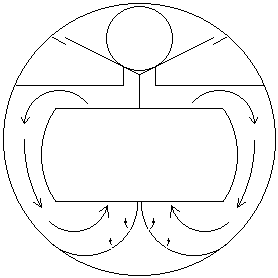 A well-designed horizontal CVP consists of a series of compartments through which the massecuite flows in almost true plug flow - the ideal model for a continuous process and the best situation for achieving a good crystal CV. Within each compartment one is seeking a rapid circulation which in some designs has resulted in a complex pan shape presenting challenges to the fabricator.
The SKIL CVP makes use of a structurally optimum cylindrical outer shell but internally incorporates smoothed massecuite flow paths which avoid stagnation zones and are critical for a close crystal residence time distribution. The design provides hot surfacess in the lower zones, encouraging upflow into the calandria and reducing the risk of crystal build-up. It also makes it easier to apply 'jigger' steam which has been proven to help compartmental circulation.
The design also incorporates longer calandria tubes than other reputable designs, again enhancing the compartmental circulation while still avoiding the boiling point elevation problems of a high head above the calandria, such as occurs during the latter part of a batch pan boiling cycle. This is achieved with the same heating surface area per unit volume and hence also reduces the cost of fabrication.
The third main improvement over alternative designs is in the passage from one compartment to the next. The SKIL CVP incorporates specific passageways in the internal baffles for this flow rather than relying on an overflow to occur.
Other improvements of lesser concern include the elimination of a separate vapour dome to further simplify the construction of the vessel: the vapour has a major portion of the ullage volume of the pan to travel to an end plate exit. Note should also be made of the chicane pathway through which the vapour travels to the vapour space, an extra entrainment eliminator.
PLAN VIEW
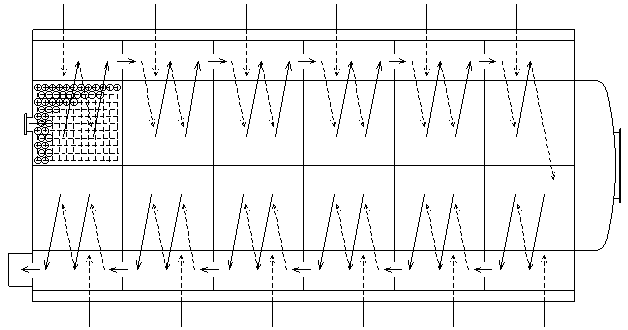 This conceptual plan section shows how the flow through the system operates from each high circulation compartment to the next. Seed magma enters the first compartment below the calandria at the upper left and massecuite overflows from the last compartment at the lower left into a vacuum seal. Syrup, molasses or water feeds are added in each compartment, also below the calandria, as required for the particular boiling. Flow through the system therefore approximates two spiral flows, flowing up through the calandria and then down the outer downtakes as shown in the cross-section above. The downtakes are areas of high flow rate and it is in these zones that the transmitters of the condition control loops are placed.


|